Today our math coach has set up an exchange between sixth grade teachers at the Middle School and fifth grade teachers from the three elementary schools. During the day we'll visit the current three different leveled math classes and then we'll have a chance to meet at the end to ask questions and exchange information and ideas.
At first, I wasn't going to attend this day because my sons have previously attended the Middle School so I have a parent perspective of the math program. Also the Middle School sends fifth grade teachers an update every year to let us know how our former students are doing. This information helps me to gauge the program I teach as well as how I coach individual students. Generally students have made a positive transition from the fifth grade program to the sixth grade math program.
Once the coach relayed the schedule, however, I asked to sign up because the schedule is not a visit alone, but instead an exchange which is an opportunity for all of us to talk deeply about the ways we teach students math. I know that the Middle School team is devoted to teaching mostly math all day and that they began a standards-based approach last year. I know that they are continually updating their program so I'm interested in the ways that they are employing current research to lift their program. I'll also look forward to seeing last year's students, and observing the many ways that the sixth grade teachers run their classrooms.
I really enjoy the ability to teach a subject with greater depth which is what the shared teaching model affords. It will be a profitable day.
Showing posts with label Learning Design. Show all posts
Showing posts with label Learning Design. Show all posts
Thursday, October 20, 2016

Wednesday, October 19, 2016
Teach Math Well: Are We Asking the Right Questions?
Emails circulated about the value of using an online unit assessment versus the paper/pencil unit assessments of the past. It's a good question, and one that should be posed and discussed. Personally, I'm a fan of using multiple formal and informal formative and summative assessments, and I support the use of online assessments as part of that overall assessment approach.
I also believe that we have to be mindful to have a good assessment balance and not make teaching and learning all about the test--we have to make space for children to enjoy their learning. While it's important to discuss assessment types and the role of assessment when teaching math, there are also many more questions that beg our attention and discussion.
For example, one of the greatest math question that we face in our standards-based school communities, and how do we continually uplift and teach the students who are one or more years behind the expectations. Of course, I believe that math education should be progressive where every child is moving ahead from where he/she is and that the focus should be on that movement rather than if everyone is at the same level. For example if I have students at fifth grade who are testing at a second grade level and others who are testing at a seventh grade level, they all should be working to move up. I don't want those "seventh grade level" fifth graders to think they've achieved all there is to know in math and sail along without a good challenge, and I also don't want those "second grade level" fifth graders to get discouraged and always feel behind. So the question, How do we challenge all in positive, proactive ways resulting in good math growth, engagement, and knowledge?, is a great question to ask and discuss amongst peers.
Another good question to discuss in math is what are the best ways for specialists, assistants, coaches, and classroom educators to work together to maximize math teaching and learning for all. We have instituted Responsive to Intervention in creative ways that help in this regard. We also differentiate during core instructional times. The way we collaborate matters when it comes to uplifting children's skills, knowledge, and concept.
Further we can ask questions about content specific teaching and learning. For example, at a recent meeting, it was acknowledged that teaching the "behavior" of the base ten place value system is challenging. Students at fifth grade find it difficult to grasp that numbers increase by X10 as they move up each place in the place value system and decrease by 1/10 as they move down in value place by place. Fluency with that concept takes time.
Time is an important consideration. Many on the outside would like teachers to work like soldiers and be at the same place in teaching at the same time. This, in many ways, negates the where students are at and what they need. It also disregards the need for educators to make the curriculum their own and teach it with the artistry, experience, and analysis needed. Good teaching is not a robotic function, and good teaching makes good use of time. Unlike a robotic response, good teaching analyzes deeply and maximizes the use of time to teach all well.
Too often we spend time talking about questions that don't matter that much in education. Instead we should dig a little deeper and spend time discussing what matters--the big, deep questions that truly impact what we can do to better teach all children.
Tuesday, October 18, 2016
Introduction to Math Workshop
Tomorrow I'll introduce students to Math Workshop.
First, I'll restate why were learning what we're learning, and the many ways students can effectively support their own learning in school and outside of school.
Then I'll say that Math Workshop is a time for you to practice what we're learning in ways that help you learn best.
I'll ask students to practice the place value skills and knowledge we studied yesterday by completing the following tasks:
- Complete the worksheet
- Check in with a teacher anytime you have questions or upon completion
- If done, practice more using Khan Academy Place Value practice, and again when you have questions ask a teacher.
There's no simple way to learn tomorrow's focus skills and knowledge without simply practicing. Students can aid their practice by making the following steps:
- Work alone or with a friend
- Focus on the task
- Use a sharpened pencil or pen that you enjoy writing with
- Take your time and work with precision
- Work quietly so others can concentrate too
I'll set up shop at the big table so that I'm accessible and available to those that need me and for those when they complete the task. Also when students pass in their assignments I'll ask them to read a number of numbers to assess their ability to read numbers.
The following day students will complete more practice items, then next week we'll focus on the "behavior" of the base ten place value system as we look closely at the ways number increase and decrease as you move up and down the place value system.
Wednesday, October 12, 2016
Fifth Grade: Systems Think
The overall focus of the fifth grade science curriculum is systems think. How might educators thread that theme throughout the math teaching/learning year too?
First, define systems with students.
I like to begin with more sophisticated definitions such as the one I found on Wikimedia.

Then I like to pull the definition apart with main words:
First, define systems with students.
I like to begin with more sophisticated definitions such as the one I found on Wikimedia.

Then I like to pull the definition apart with main words:
- interacting or interdependent parts forming a complex/intricate whole.
- surrounded and influenced by its environment
- described by its structure and purpose
- expressed in its functioning or behavior
- also refers to a set of rules that governs structure or behavior
After that I put together a fifth grade friendly and memorable definition, one we can return to each time we discuss a new system in math. For example, we can describe systems in this way:
A system is parts that work together with with structure(s), purpose, and behavior to create specific function(s) or result(s).
With that definition students can study each math unit with a "systems lens" that focuses on the following questions:
- What is the title(s) of this system?
- What are the parts of this system?
- What is the structure (framework) of this system? How can we model and describe this?
- Why was this system created? What is its purpose?
- How does this system work, act, or behave?
- What is the result or function of this system? What does this system help us to do?
As we study the base-ten place value system, we'll answer these questions.
How do you help fifth grade students to learn math with a systems lens? Why is this important? How will it affect their learning and understanding? What would you add to this approach?
Wednesday, October 5, 2016
Khan Academy Fan

I continue to be a Khan Academy fan. His well supported learning/teaching platform provides students with helpful videos and practice exercises. Students may practice a skill again and again, and teachers and parents can use the platform to help support children.
As you can see from the chart above, my students have just started using Khan Academy to practice fifth grade math standards. Most students have completed less than 10% of the practice exercises so far this year. One chid has almost finished fifth grade so he'll likely move ahead to sixth grade.
In addition, Khan provides students with coding exercises and learning. Yesterday I introduced several students to those exercises. They were very excited.
We're fortunate to have free access to the incredible learning tools that Khan Academy provides. The key is to coach and teach students how to use these tools as one way to support their learning. Tools like Khan Academy support the fact that "the sky's the limit" when it comes to what's possible in teaching and learning today.
Thursday, September 29, 2016
Ingredients to Successful Math Education
Year after year I'm reminded of some of the ingredients to successful math teaching and learning. Ingredients that include the following:
- Well organized and planned learning experiences
- Putting children's interests and needs first
- Assessment, reflection, and needed revision
- Response and record keeping
- Meaningful facts, figures, and scenarios
- Teamwork and collaboration
- Openness to new ideas
- Learning and research
- Multi-modal approach
- Sufficient repetition
- Time-on-task with students
It's the day by day efforts that employ the strategies above that lead to apt teaching and learning.
Wednesday, September 14, 2016
STEAM Teams: Introducing the Design Process

Last year's reflections about the Global Cardboard Challenge pointed to the fact that we had to utilize a more explicit team building and design thinking introduction and process before jumping into the Global Cardboard Challenge. We felt that laying a good teamwork and design process foundation would lead to greater satisfaction and successful inclusion with regard to the overall project.
With this in mind, students got together yesterday with their Global Cardboard Challenge STEAM teams--teams created with teacher and student choice and voice. We sang the Lego movie song and discussed whether "Everything is awesome and cool when you're working with a team." Students were quick to mention that teamwork can be difficult, and that's when we watched Kid President's latest video about how to disagree:

Next, I'll tell students that we're adopting IDEO's design process illustrated below. And then we'll use that process to map out a Global Cardboard Challenge project together. Tomorrow groups will begin the project in earnest designing their individual team projects as we prepare for Friday's Team Build Day.

Sunday, September 11, 2016
What Do You Do When a Child Arrives at a Grade Level "Behind" the Others with Regard to the Standards?
 |
| A great resource for math teaching and learning. |
To answer my own question, I will create Boaler's "floor to ceiling" learning experiences that have what I've always called the 1-2-3 approach where 1 is review, 2 is grade level, and 3 is enrichment. I always open all levels to all students. Willingham in his book, Why Don't Students Like School, affirms the opportunity that exists when students review material that they "know" since there's always more depth to be gained by that review. I know that to be true because I've taught similar standards for years and each time I teach the standards anew I make more connections and learn more.
So with this 1-2-3 or "floor-to-ceiling" approach what's important and how does it work?
It works like this. Students enter the experience at level 1 with a review. For some the review will be quick and pointed, and for others the review stage will represent new learning. Level two is the grade-level norm or standard, and the place that we hope most students will master with the support of educators, classmates, and family members. The third level is enrichment and it's open to all. I find that when I open the enrichment level to all, it's amazing to see who reaches since it's never just those students you'd expect to reach. Often a child who struggles in one area of math may reach in another. That's why I'm not a fan of permanent grouping especially in the early years. I like the flexible grouping we use during RTI related to specific skills, knowledge, and concept goals.
 |
| Another great book when it comes to matching learning with how the brain works. |
- Introduce everyone to the big idea in an intriguing way.
- Scaffold the experience so there are levels 1-2-3 and all levels are open to all.
- Leave the experience "loose-tight" with plenty of room for student choice and voice.
- Make time and space for discussion, share, and response.
- Use teamwork when possible and be strategic about how you create groups. Use a variety of group types so that students are working with like-partners, unlike-partners, mixed-ability groups, like-ability groups, interest-based groups, and more. As you employ various types of grouping, observe which groups inspire, engage, motivate, and forward student learning.
- Use strengths/interest-based content and approaches as much as possibly and introduce many ways to learn and let students try out all the various ways to learn too.
We can't predict how a child one or more years away from the curriculum grade-level standards will learn and grow. Sometimes when a learning experience is truly engaging, a child will leap ahead and demonstrate significant growth. Sometimes students will do this even if the experience isn't engaging as they reach a point of cognitive shift that helps them to merge and consolidate ideas with greater ease and strength.
There are also times when a student remains stuck with a concept, knowledge, or skill. Give it the good try in multiple ways, and then take a break and return to that learning point later.
 |
| Learning is not linear. |
How do you teach students who are behind when it comes to standards learning? Please share as I want to broaden my understanding of this as much as possible as I now we can grow our expertise in this area.
Saturday, September 10, 2016
Analyzing Students' Work Habits, Attitude, and Social Skills Survey
I took all of the work habits and social skill standards from our report card and a few more standards that I include in my teaching and added them to a Google form student survey. Students took the survey. Just taking the survey gave students a chance to think about the language and standards with regard to expectations and attitudes and behaviors for learning success.
Now I'll take the results that represent about 2/3 of the student response (there's still more students to take the survey and I'll update the response accordingly), and give students a chance to analyze the data.
With their math teams, I'll have students study the data chart below. Similar to the way our teaching team analyses data, I'll ask students to first share what they notice. Then we'll share questions that arise about the data. After that we'll discuss how this data set might affect individual's and the class's learning and teaching this year.
As I look at the data, my next steps include the following:
- Recognize that most students have great attitudes and work skills.
- Look for the individual students who answered "rarely" or "never" to see if there are any patterns there. If it's the same student, I want to sit down and talk to that student. If it's a few students, I may have a small group devoted to this.
- Look at the "other" comments and those that made those comments. I want to take their words seriously and see how that might affect my teaching and learning.
- Look closely at the areas where there was more scatter, and talk to students about how we might help the whole class to achieve in those areas.
- Think about categories that are not included in this survey--categories that are integral to learning well today. What would you add?
There were also a few errors in the survey that I need to correct. Students will take this survey including the new questions added again in January before we mark the progress reports. I'll be interested to see how the explicit teaching and learning we'll do together now will affect the results then.

Wednesday, August 10, 2016
How Do You Keep Up with the Research?
 |
| Boaler's research points to the advantage of collaboration for students, and it can be inferred that this collaboration works for educator development too. |
I thought a lot about what I wanted to present and lead. I knew I wanted it to connect to my "word," the acronym that will lead my work this year: TOME - Teamwork, Observation/Reflection, Math w/STEAM, and Everyday Learning, and I knew that I wanted to choose a topic that would contribute towards creating a useful, valuable math learning community.
I decided to propose a 15-hour learning event that would help colleagues and I to keep up on the latest research and literature related to math teaching. In addition, I chose to include creating websites and "hosting conversations" information and practice within the learning event. Hence educators who choose to sign up will engage in the following activities:
- create a learning/teaching website,
- read, study, and reflect on new research related to math education,
- engage in collaborative conversation that leads to wise action ("hosting conversations")
- readily apply the research to their current math teaching
- reflect and share the application of research to their teaching and its results
I've come to realize that the best presentations I offer are presentations I'm curious about and invested in--presentations that serve to create conversation, encourage collaboration, and result in positive student learning.
How does your system support collegial share and professional learning? How do you contribute to these efforts? When do these efforts result in meaningful learning and share?
I wonder if any or many will sign up for my class? One obstacle to this is that teachers' schedules are very tight leaving little room for extra study. Yet, one strength is that teachers can earn a salary increment credit and Professional Development Points (PDPs). Also, it will provide educators with evidence for their evaluation goals and provide them with a collegial team with whom to develop their math teaching and learning.
Let's see what happens.
Tuesday, July 26, 2016
Merge Learning Mindsets/Behavior Lessons with Content Focus

Particularly at the beginning of the school year, it's essential to merge learning-to-learn mindset and behavior lessons with content focus. This integration helps students to gain confidence and skill as a learner as well as acquire the math content knowledge, concept, and skill.
The best way to do this is to have a ready list of learning-to-learn behavior/mindset lessons and match those lessons to the daily focus. For example I'll match a focus on collaboration with an initial number review and assessment during the Math Team T-Shirt lesson and the Global Cardboard Challenge project.
I'll weave more of the lessons from my Learning Mindsets and Behaviors website into other math lessons as well. Last year I did this regularly, and every time I focused on a learning to learn mindset and/or behavior lesson, I saw students sit up straighter with bright eyes as these lessons served to empower them and let them know that I knew everyone in the class was capable of success.
In a sense, the learning mindset and behavior lessons are catchy introductions that motivate the best of what students can do. In many cases, these lessons dispel long held myths about learning that students have learned at home and in the broader culture, myths such as some people can learn and others cannot.
To build this empowerment out event more, after I've exhausted my learning behavior and mindset lessons, I'll weave in current events, notable experts from all cultures, races, lifestyles, and religions, and new content and discovery. These kinds of introductions also serve to empower and engage students while making math meaningful. Valuable learning experiences always include a strong rationale as well as ways to make the learning brain-friendly and successful.
Please feel free to use the lessons I've created on my Learning Mindsets and Behaviors website--blended lessons that invite students into the learning. Also if you have other great empowering learning experience additions, please let me know. Motivating, engaging, and welcoming students to learning is as important as the content, concept, and skill learning--it takes both areas of focus to reach successful teaching and long term investment and learning success.
This little film is one example of an introduction I share at the start of the year--it's amazing to see how many students view this as new knowledge when they watch it and we discuss what it means.
Successful Math Community: Explicit Routines

Many elementary school teachers are masters at routine--they establish good routines at the start of the year and stick to those routines all year long. Others find this more of a challenge. A routine-oriented teacher is not better than the other, but the truth is that good routines create greater freedom and time for deep, meaningful, and joyful learning.
What routines matter with regard to your math classroom?
Transitions
Since our students move from classroom to classroom, making the time to teach transitions is integral to using time well. My colleagues did a great job with this last year, and I want to listen to their strategies so I can follow their lead. Good transitions save time and prepare everyone for quality learning.
Respectful, Targeted Use of Supplies
Since students move from place to place, they each have a drawer in the math classroom for their math notebooks and baggy full of supplies. It's important to make sure that everyone has the needed supplies including a grid notebook, pencil sharpener, colored pencils, and fine line marker at the start of the year. It's also important that shared supplies such as scissors, rulers, protractors, and manipulatives are easy to access, use, and put away. Early year introduction to supply locations, care, use, and clean-up sets the stage for a successful year.
Learning Experience Routines
Generally the learning experiences will follow a basic routine each day. In my class, students generally have an introduction, time to study, learn, make, or practice, and a closing comment or share. It's important to explicitly teach the routine so students know what to expect. You can ask students to monitor the routine too so that most of the time is their time to learn, create, share, and practice.
Speaking and Listening
One of the greatest challenges of classroom life is that you're typically working with large numbers of students at a time, that's why it's important to set speaking and listening rules and rationale up front. Typically, these rules lead speaking and listening:
- Raise your hand if you'd like to speak.
- Keep your hand down if someone else is speaking and then raise your hand when they are done if you'd like to say something.
- Speak with a strong voice so everyone can hear. It's advantageous to have a microphone available for the soft spoken students.
- Don't side talk when someone else is speaking.
- Listen carefully to what someone is saying, and if you want to add, but afraid you'll forget, write down your thoughts in your notebook so you're ready to share when the time comes.
Clean-Up
It's good to explicitly talk about and practice clean-up routines and expectations. Large numbers of students can make a big mess and it's important that they know how to clean it up.
Ask Questions, Seek Help
Students need to advocate for themselves, and it's important that we teach students how to do this. Generally I let students know that they can write me a note, seek me out when available, or email me if they have questions or need help. If it's an emergency, I tell them to interrupt me right away, and for leaving the room for the restroom or other reasons, we have a hand signal so it doesn't take too much time from the learning.
Organization
Teach students how to organize their supplies in varying work spaces and for a diversity of projects. For many students, organization is not natural and to provide students with organization tips can really help them succeed.
Rules, Policies, and Protocols
It's important to review the "Never Go There" rules--rules that have to do with safety, rules such as how to use scissors, never throw things, don't use bad words, no name calling, and safe use of appropriate tools on the computer. You can ask students to add to this list. I tell students that it's always good to have a "Never Do That or Go There" list so that they don't do the things in life they can't reverse--actions that truly disrupt and hurt others.
Then we talk about general policies and protocols--what to do. Students will readily come up with this list. With the upcoming election in the news, this can be matched with the creation of a class constitution which is an effective way to learn about our government and govern the class too.
These are some important routines to explicitly teach during the first six weeks of classroom life. Ruth Charney's book, Teaching Children to Care, further outlines important attributes of school life--elements that invite all children to a year of successful learning.
I'm sure I'll add to this list in days to come, and in the meantime, if you have anything you would add, please let me know.
Teamwork Builds Math Mastery

At the start of the math year, build teamwork by employing the Global Cardboard challenge. Also emphasize team in explicit ways through the Global Cardboard Challenge efforts and via the strategies and information included in the presentation below. It's worth the time to build a dynamic, purposeful sense of team at the start of the school year.
Monday, July 25, 2016
Making Teaching/Learning Goals Explicit
Too often goal setting doesn't result in good work. This is often true because the goal setting does not identify the success criteria and tracking processes upfront.
To set a goal and move towards that goal with careful thought and attention is an amazing process. To honestly identify the goal's movement from start to finish provides information that helps us to reach the goal with strength, and reaching a goal with strength means that we're doing the work we set out to do.
As I think about my teaching/learning goals, goals that are mandated by the Massachusetts' Educator Evaluation system, I want to clearly identify the success criteria and tracking process.
Student Learning Goal
Students will progress in the following areas:
Formal and informal formative and summative assessments will demonstrate growth. Assessments will include the following:
To set a goal and move towards that goal with careful thought and attention is an amazing process. To honestly identify the goal's movement from start to finish provides information that helps us to reach the goal with strength, and reaching a goal with strength means that we're doing the work we set out to do.
As I think about my teaching/learning goals, goals that are mandated by the Massachusetts' Educator Evaluation system, I want to clearly identify the success criteria and tracking process.
Student Learning Goal
Students will progress in the following areas:
- Identified fifth grade math standards
- Identified learning-to-learn mindsets and behavior with a focus on collaboration, character, perseverance, organization, empathy, confidence, self-awareness, and self-advocacy
Formal and informal formative and summative assessments will demonstrate growth. Assessments will include the following:
- Math Progress: Content, Concept, Skill Assessments, Project Work, and Oral/Written Reflections.
- Learning-to-Learn Mindsets and Behavior Assessments: Observation, conversation, reflection, project work.
- With acknowledgement of new ESSA requirements, tracking will identify growth for all students including the categories of economically disadvantaged, English Language Learners, Special Needs, and Historically Underserved Cultural/Racial Groups.
Teaching/Learning Path
The path to meet these goals will include the following elements:
- Explicit introduction, discussion, and goal setting related to each goal.
- Transparent, inclusive student-teacher project work, practice, reflection, revision, and assessments as part of the overall learning/teaching process
- Open, honest communication with the learning team related to teach goal and the activity related to that goal
- Regular parent/student meetings and communication related to individual coaching for each goal.
- Extra support where needed to support children's needs related to the goals above.
I look forward to explicitly sharing the goals, success criteria, and tracking processes above with students as we learn. I will not explicitly discuss the ESSA goal categories with the whole class to avoid any kind of judgement, prejudice, or name calling. However, I will pay attention to those categories as I teach and look for ways that I can build greater cultural proficiency to make good growth for all students including those specifically identified by ESSA.
A tight focus as noted makes the teaching/learning year more interesting and focused on what I can do for and with children. We know that good progress mostly depends on the relationships we make with students and the time and attention we invest in each child. Our good work matters in this regard.
Friday, July 8, 2016
Use Amazing Numbers in Math Class
Math class becomes a lot more interesting when you use amazing numbers.
You may easily teach math concept, knowledge, and skill by analyzing the math in current events articles and situations. Today's amazing space article is an article that will be understood much more with mathematical reasoning.
Below I'm going to collect a number of articles that provide a good stage for mathwork--articles that will lead students to use math well to understand the world around them.
Space Articles
New Planet with Three Suns
Thursday, July 7, 2016
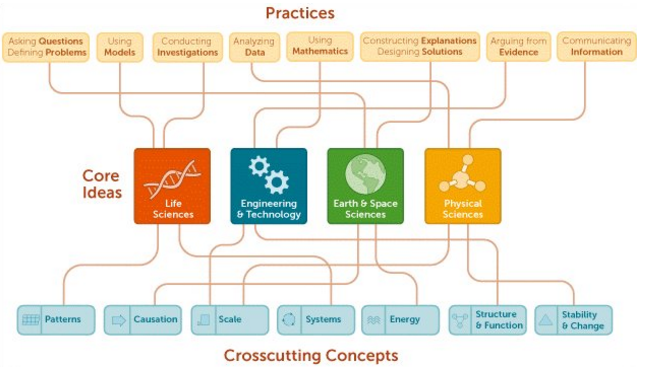
Math Focus: Integrating Math/Science Practices and Crosscutting Concepts

 |
| Standards of Mathematical Practice |
I'm intrigued by the way that big ideas and overarching practices are woven into learning design. As I look at the charts above and think about the Math/STEAM program I'll teach next year, I wonder how I will integrate these skills, standards, and concepts.
Overall the practices lead us to inspire and develop inquisitive students who explore their world in logical, reasonable ways. We give students the opportunity to develop a keen, creative, and critical lens for looking at, interpreting, and interacting with the world. Helping students to see and interact with their world in this way creates both practical and creative thinkers--people who are confident and proactive about traversing their environment with understanding, problem solving skills, and intuition.
I've come up with a host of questions that will lead students' thinking and study in this regard. What would you add? How do you plan to embed the math and science practices, standards, and crosscutting concepts into your teaching/learning efforts next year and in the years to come?
Practices/Standards
- What is your question?
- Can you specify, identify, define, or describe the problem to me?
- What patterns, regularity, process, and structure do we notice in this situation?
- How can we create and conduct a process or investigation to gain understanding and/or solve a problem? What regularity, patterns, processes, and structure can we use to investigate, understand, and solve?
- How do you plan to persevere to solve this problem? What steps will you take?
- What tools and other resources will help us to solve this problem and/or answer this question?
- How can we use the tools and resources appropriately and strategically?
- Can you create a model of that to explain your thinking or what's happening?
- How can we use the model to simplify the problem in order to reason abstractly and/or quantitatively about what is happening or has happened?
- Are we able to determine a relationship(s) in this situation? How can we define that relationship
- What specific mathematics will help us to understand, prove, or present this better?
- How can we explain this in a step-by-step, logical, and explicit manner?
- Can we come up with a number of solutions to this problem, and then choose one that we think will be the best?
- How would you defend your idea in this situation?
- How can you critique the ideas of others?
- Is our thinking, process, efforts, and result precise? Did we check our work by our selves and with others?
- What is the best way to communicate these ideas, facts, and/or information to others? How can we help others to understand?
- Is our thinking reasonable? Why or why not?
Crosscutting Concepts
- What patterns do you see?
- How would you define your daily, weekly patterns?
- What caused this? What led up to this situation? What was the effect?
- What is the scale? How often does that happen? What are the actual statistics? Are we talking one, ten, a hundred, or a million? Is this a rare occurrence or an every day event?
- Where did the energy (ability to do work) come from? What obstacles slowed energy down, and what created more energy?
- Is the matter a liquid, solid, or gas? What properties define matter? How does the matter look and feel? How does the matter behave? How can we manipulate the matter?
- How is it structured? Does the structure lend itself to the results we're looking for? Can we change structure (form) to impact its function in more useful, efficient, beautiful, or desired ways?
- What is mostly stable in your life? What changes frequently? In nature, what can we typically expect? What changes happen over a long period of time; what changes often; and what kinds of unexpected changes occur?
- How would you compare the size, frequency, distance, or other measurements? What is the proportion? How often did this happen? How many? (quantity)
- Where does this lie in the system? How does the system work? What are the system parts and how do they work together to form an efficient, effective system? What system will you create?
Thursday, June 30, 2016
Fifteen: Building Positive Math Teams and Mindsets

To spur a conversation about team and what matters, I'll show one of my favorite teamwork videos:
I'll also use other resources that I've collected to inspire positive teamwork.
I'll likely include the attributes Boaler uses to describe mathematicians, mathematical thinking, and math study, attributes included in the presentation below. It's possible that students and I will create online or real-time signage as teams to post and refer to throughout the year to remind us of these attributes as we study and learn math. An emphasis on collaboration and mathematical mindsets at the start of the year will set the stage for a positive, collaborative, and open-minded math teaching/learning community.
Fourteen: Creating Class Community and Introduction to Line Plots

Therefore, I prefer to begin the year by introducing students to the main vocabulary, tools, and concepts we'll study all year long in student-friendly, engaging ways. I don't detour too much from the standards as if I do that, I don't have the time to reach the expectations set by system and state standards.
One early review and community building lesson at the start of the year is the introduction to line plots. Introducing line plots with student- and family-friendly data points leads to community building and also allows students to review/learn a math concept/skill that they can apply throughout the year as they study multiple concepts in math.
To begin this study, students and I will create a data chart that includes data about the following student information:
- letters in first name
- birthday month number
- birthday number
- favorite numbers between 0-12
Note that the information items I use at the start of the year do not include information that could create worrisome comparisons or share. Then we'll create line plots for the data. We'll display the line plots for review and discussion.
For homework students will create similar line plots to describe family members. The following day we'll likely review, share, and write about those family line plots as I introduce math writing and math talk routines and protocols.
Throughout the year, we'll revisit our line plot work as we create more and more sophisticated line plots related to measurement and fraction understanding and problem solving.
We'll use videos like the one below to develop knowledge and also to teach students how they might access videos online via our class website and elsewhere to aid their math learning and study.
Math Direction: Ten Questions Lead the Way

Ten questions will lead the 2016-2017 fifth grade math teaching/learning program.
1. Who are we? What do we know and what do we want to know?
As we discuss who we are as a learning team of students, teachers, and family members, we'll think about the ways that we can collect and analyze data to create an infographic and other models of who our learning team is. Then we'll draw from that data all year.
- Line Plot Lesson
- Assessments: Behaviors/Mindset, 5th Grade CCSS Standards, Facts
- Coordinate Grids - Where we live and learn?
2. How does our community behave?
We'll engage in a number of teaching/learning experiences that focus on apt discipline and behavior for optimal math study, practice, and share.
- Lessons from Learning Mindset and Behavior website.
- Building Team
- Global Cardbard Challenge
- Khan Academy Introduction, Study
3. What are the digits? What are numbers? What do we know about the landmark numbers 1-12, 25, 50, 75, 100, 200, 500, 1,000?
As we review operations, math facts, math vocabulary, and order of operations, we'll explore the world of the number 0-12. This study provides a good review and lays a valuable foundation for year's math study. This focus also provides a terrific way to introduce multiple math tools including rulers, calculators, tech tools, and coordinate grids.
- Landmark Number Lessons
- Divisibility Rules
- Numerical Expression
4. In what ways can we analyze, discuss, and measure?
Students will create and study two-dimensional and three-dimensional figures as they learn about geometry, area, perimeter, and volume.
5. How does the base ten system behave?
We'll explore the "behavior" of the base ten system in multiple ways, and hopefully work to make models and code animations that demonstrate this behavior.
6. How do we "operate" on numbers?
Students will study, review, and apply number operations as they create and solve real-world multi-step math problems.
7. When and how do we measure length, capacity, and mass? What is proportional reasoning?
Practicing measurement with problems related to matter.
8. What's the difference between whole numbers and fraction/decimal parts?
We'll look at the relationships between and amongst whole numbers, fractions, and decimals. We'll explore where and why we use the various numbers and how we manipulate these numbers using many models, operations, and algorithms?
9. How does math help us to solve real world problems successfully?
10. What place does math hold when it comes to STEAM projects, exploration, and study?
I am just starting to explore the use of big questions to lead each math unit. I am not yet satisfied with these questions, but will continue to brainstorm more about this as I consider the strength and areas for growth with regard to this year's teaching and learning in math.
I welcome your wisdom in this regard.
Friday, June 24, 2016
Twelve: Goal Setting and the Language of Learning
 |
| Note that much of this language came from John Hattie's book, Visible Learning for Teachers, Maximizing Impact on Learning |
Prior to the assessment we discussed learning. I told the students that true learning causes change--a change in action, attitude, ideas, and/or knowledge.
Then I told them that there is a success process when it comes to learning. I showed them the diagram above and we reviewed each step with the story of how I learned to teach my son to ride a bike, and how they'll use this process to meet their fact fluency goal:
Step One: A desire or need to learn.
My son was seven, and he couldn't ride a bike. The children in the neighborhood were riding bikes, and we were going on bike rides as a family. The fact that he couldn't ride a bike meant he was left out of friend and family activities. He desired to ride a bike, and we knew that this was a need.
Similarly, students need to become facile at math facts in order to learn math at a higher level with ease and success. This isn't true in all cases, but it is true in most cases, hence this is a fourth grade goal.
Step Two: Determine Success Criteria
In this case, it's easy, the success criteria is riding a bike.
For facts, our goal is 50 facts of each operation in three minutes or less with three or fewer errors.
Step Three: Assess
What did my son know at the start of this learning journey? He could ride a bike with training wheels.
What do students know as they start their math fact learning journey. Students took a series of That Quiz tests to find out.
Step Four: Plan and Strategize
I planned to hold on, push forward, and run close to my son to help him learn.
Students will make a plan to reach their fact goal. Students will choose from a number of strategies.
Step Five: Act, Adapt, and Assess.
At first I tried to teach my son to ride his bike on a bumpy, hilly tar road. That didn't work. Then I brought him to a flat, part pavement-part grass school playground. I also added a $ bribe to encourage him to try. That worked.
Students will try out their plan. We'll assess regularly and adapt the plan as needed so that they reach their goals. There will be in-school parts of the plan and at-home parts.
Step Six: Final Assessment/Next Steps
My son's final assessment was done by observation. I observed that he had learned to ride and was ready to ride wherever he wanted to. The next step was to take him on some bike hikes and teach him about safe bike riding.
In class, students will choose when they are ready to take the test for each operation.
Step Seven: A New Goal!
We'll revisit this learning process regularly this year as children begin to understand that they're in the driver's seat of their education--they are the most important people when it comes to setting and meeting worthwhile learning goals.
Subscribe to:
Posts (Atom)